
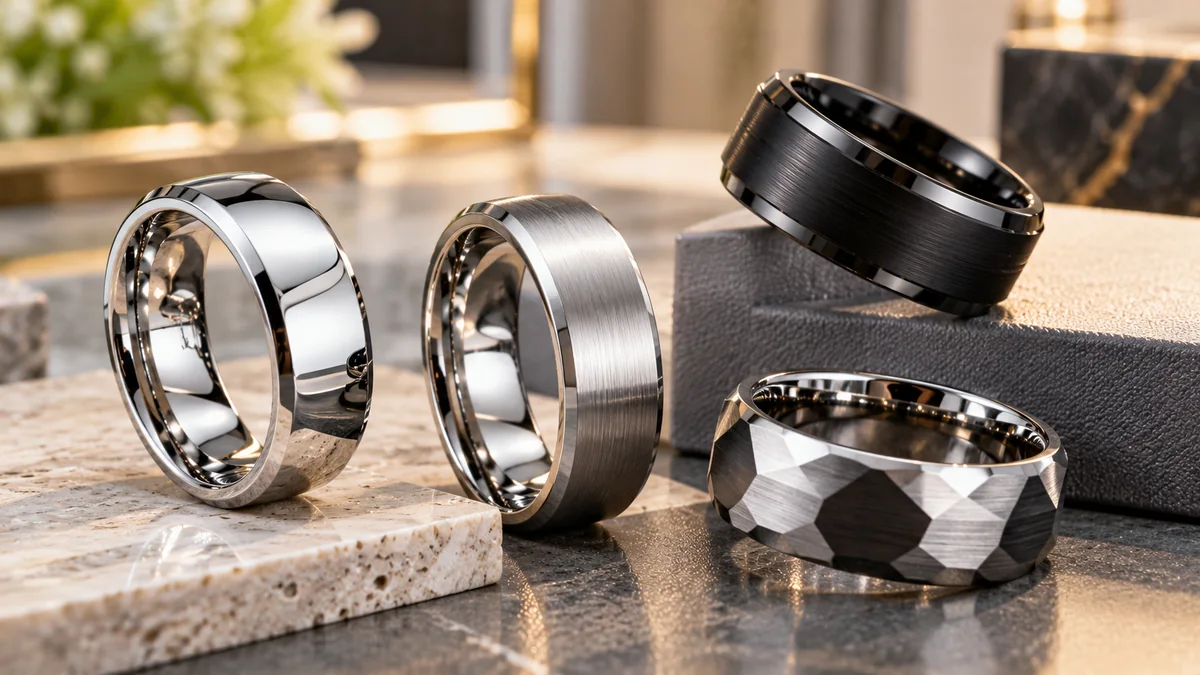
Two tungsten wedding bands can use the same core material and still look completely different because of the surface finish and edge design. Tungsten ring finishes influence how much light a band reflects, whether the style feels classic or industrial, and how strongly details such as grooves, bevels, stripes, or inlays stand out.
IntelliRings currently carries more than 150 tungsten-ring styles, including brushed, polished, black, silver, colored, beveled, faceted, and inlay designs, so understanding finish terminology makes the catalog easier to compare.
The Main Finish Terms You Will See
|
Finish / Shape |
Visual Effect |
Good Fit for Shoppers Who Want |
|
Polished / mirror |
Bright, reflective surface that catches light strongly. |
A classic jewelry look or high contrast with dark/colored details. |
|
Brushed / satin |
Fine linear texture with softer reflection. |
A modern, understated appearance with less mirror-like shine. |
|
Flat profile |
Straight outer surface rather than a rounded dome. |
A clean, contemporary silhouette. |
|
Beveled edges |
Angled edge surfaces that frame the center of the ring. |
Extra definition and contrast around a brushed or colored center. |
|
Faceted |
Multiple angled faces that reflect light in separate planes. |
A geometric, architectural look with more visual texture. |
1. Polished Tungsten: Maximum Reflection
A polished tungsten band has a highly reflective surface. Silver-toned polished tungsten can resemble the visual brightness of other white-metal jewelry, while black, blue, gold, or rose-gold colored designs can use polished edges to create contrast.
Polished does not mean scratch-proof. Tungsten carbide is known for hardness, but decorative surface treatments, coatings, grooves, inlays, and edge details can have different wear characteristics. Judge the whole ring design, not only the core material.
2. Brushed Tungsten: Softer and More Understated
Brushed finishes use fine directional texture to reduce mirror-like reflection. The result often looks more matte or satin from a normal viewing distance.
The IntelliRings catalog includes a silver tungsten ring with a brushed finish as well as black and mixed-finish styles that combine a brushed center with polished or beveled edges.
3. Beveled Edges Change the Ring Without Changing the Center
A bevel is an angled edge cut around one or both sides of the band. It can make a simple flat ring feel sharper and more structured, and it creates a separate surface that may be polished even when the center is brushed.
For example, IntelliRings lists a black brushed-finish tungsten ring with beveled edges, illustrating how edge geometry and finish work together.
4. Faceted Designs Add Geometric Reflection
Faceted rings use multiple flat or angled planes rather than one continuous smooth surface. Each facet catches light differently, so the ring can look more dynamic as the hand moves.
Faceting is primarily a design choice. The exact number, depth, and direction of the facets affect appearance more than the generic word ‘faceted’ does.
5. Flat vs. Domed Profiles
Finish describes the surface; profile describes the shape. A ring can be polished and flat, brushed and domed, or faceted with beveled edges.
Flat profile: more linear and modern, especially in wider bands.
Domed profile: rounded outer surface with a traditional wedding-band silhouette.
Stepped or beveled profile: creates multiple visual levels around the band.
How Finish Interacts With Ring Width
A wide band gives the finish more visible surface area. Brushing, grooves, facets, stripes, and inlays therefore look more prominent on many 8mm or 10mm designs than on a narrower band.
Width also changes how the ring feels on the hand. If you are deciding between common proportions, IntelliRings has already published a separate guide comparing 6mm and 8mm tungsten bands; use finish as a second decision after you narrow down the width you prefer.
Finish and Engraving Serve Different Purposes
Exterior finish controls the visible surface. Engraving is usually added inside the band so a name, date, coordinate, symbol, or phrase can be personalized without competing with the outside design.
For personalization planning, see IntelliRings’ wedding band engraving ideas and consider finish, width, exterior detail, and engraving together.
A Simple Way to Choose a Finish
Decide whether you prefer high shine or a softer satin look.
Choose the overall profile: flat, domed, stepped, beveled, or faceted.
Decide whether you want one finish or mixed polished/brushed surfaces.
Compare the finish at the width you actually plan to wear.
Consider how exterior details such as grooves, color, or inlays will compete with or complement the finish.
Verify the exact product photos and description before ordering because finish terminology can vary by design.
Browse by Design, Not Just by Color
Color is often the first filter shoppers use, but finish can change the personality of the same color dramatically. A polished black ring can feel sleek and formal; a brushed black band can feel more subdued; a faceted silver band can look architectural even without color.
You can compare current designs in the IntelliRings tungsten-ring collection or browse all rings to see how finish, width, color, and inlays are combined.
Sources and References
IntelliRings – Tungsten Rings Collection
IntelliRings – Brushed Finish Silver Tungsten Ring
IntelliRings – Black Brushed Tungsten Ring with Beveled Edges
Frequently Asked Questions
Is a brushed tungsten ring the same as a matte tungsten ring?
They can look similar, but the terms are not always identical. A brushed finish usually shows fine directional texture, while 'matte' can be used more broadly for a low-reflection surface. Check the product photos and description for the exact ring.
Does a polished tungsten ring stay mirror-shiny forever?
No jewelry surface should be assumed to remain visually unchanged forever. The tungsten core is hard, but coatings, colored treatments, grooves, inlays, and decorative surfaces can wear differently. Follow the care and warranty information for the exact product.
Do beveled edges make a tungsten ring wider?
The listed ring width is still the key measurement. Beveled edges change the shape and visual proportions of that width rather than automatically making the ring wider.